Insulin glargine, marketed under the names Lantus among others, is a long-acting insulin, used in the management of type I and type II diabetes.[3] It is typically the recommended long acting insulin in the United Kingdom.[4] It is used once a day as an injection just under the skin.[3] Effects generally begin an hour after use.[3]


Common side effects include low blood sugar, problems at the site of injection, itchiness, and weight gain.[3] Other serious side effects include low blood potassium.[3] NPH insulin rather than insulin glargine is generally preferred in pregnancy.[4] After injection microcrystals slowly release insulin for about 24 hours.[3] This insulin causes body tissues to absorb glucose from the blood and decreases glucose production by the liver.[3]
Insulin glargine was approved for medical use in the United States in 2000.[3] In 2018, it was the 26th most commonly prescribed medication in the United States with more than 24 million prescriptions.[5][6]
Medical uses
The long-acting insulin class, which includes insulin glargine, do not appear much better than neutral protamine Hagedorn (NPH) insulin, but do have a greater cost, making them, as of 2010, not cost effective for the treatment of type 2 diabetes.[7] It is unclear if there is a difference in hypoglycemia, given the significance of dose, and not enough data to determine any differences with respect to long term outcomes.[8] It is not typically the recommended long acting insulin in the United Kingdom.[4]
Mixing with other insulins
Unlike some other longer-acting insulins, glargine must not be diluted or mixed with other insulin or solution in the same syringe.[9] However, this restriction has been questioned.[10]
Adverse effects
Common side effects include low blood sugar, problems at the site of injection, itchiness, and weight gain.[3] Serious side effects include low blood potassium.[3]
As of 2012, tentative evidence shows no association between insulin glargine and cancer.[11] Previous studies had raised concerns.[12]
Pharmacology
Mechanism of action
Insulin glargine differs from human insulin by replacing asparagine with glycine in position 21 of the A-chain and by carboxy-terminal extension of B-chain by 2 arginine residues. The arginine amino acids shift the isoelectric point from a pH of 5.4 to 6.7, making the molecule more soluble at an acidic pH and less soluble at physiological pH. The isoelectric shift also allows for the subcutaneous injection of a clear solution. The glycine substitution prevents deamidation of the acid-sensitive asparagine at acidic pH. In the neutral subcutaneous space, higher-order aggregates form, resulting in a slow, peakless dissolution and absorption of insulin from the site of injection.[13] It can achieve a peakless level for at least 24 hours.
Acceptance and repartition in the body
Insulin glargine is formulated at an acidic pH 4, where it is completely water-soluble. After subcutaneous injection of the acidic solute (which can cause discomfort and a stinging sensation), when a physiologic pH (approximately 7.4) is achieved the increase in pH causes the insulin to come out of solution resulting in the formation of higher order aggregates of insulin hexamers. The higher order aggregation slows the dissociation of the hexamers into insulin monomers, the functional and physiologically active unit of insulin. This gradual process ensures that small amounts of insulin glargine are released into the body continuously, giving an almost peakless profile.
History
The development of insulin glargine took place at Sanofi-Aventis's biotechnology competence center in Frankfurt-Höchst. Sanofi supplies the product to over 100 countries and more than 3.5 million patients worldwide. This makes Lantus Germany's largest and most important export pharmaceutical product. Sanofi-Aventis increased its turn-over with Lantus around 28% to €2.45 million, of which €130 million was from Germany, where approximately 1.8 million people with diabetes use the product. In 2007, Lantus was the 15th highest selling pharmaceutical product in Germany.[citation needed]
The investment in the production of Lantus and insulin pen manufacturing in Frankfurt-Höchst cost €700 million. In 2008 a new manufacturing plant was established for further insulin pen manufacturing with an investment of €150 million. At Sanofi-Aventis the production of Lantus created 3000 jobs in Berlin and Frankfurt-Höchst.[citation needed]
On June 9, 2000, the European Commission formally approved the launching of Lantus by Sanofi-Aventis Germany Ltd. in the entire European Union.[14] The admission was prolonged on June 9, 2005.[15]
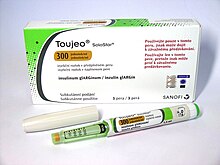
A three-fold more concentrated formulation, brand name "Toujeo", was introduced after FDA approval in 2015.[16][17]
Patent expiry
Patent protection for insulin glargine expired in most countries in 2015[citation needed] and in the U.S.A. is expected to expire on 2027-07-05.[18] Insulin glargine from competitor Eli Lilly became available in most countries during 2015, under the brand names Basaglar (as a follow-on in the US) and Abasaglar (as a biosimilar in the EU).[citation needed] Biosimilar insulin glargine has only been released in 100U/mL strength to date, and biosimilar equivalents in the 300U/mL strength of Toujeo are yet to launch.[19]
| This article uses material from the Wikipedia article Metasyntactic variable, which is released under the Creative Commons Attribution-ShareAlike 3.0 Unported License. |