Insulin lispro

 Insulin lispro, sold under the brand name Humalog among others, is a type of insulin used to treat type 1 and type 2 diabetes.[3] Typically it is taken around the time of eating.[3] It is used by injection under the skin or within an insulin pump.[3][4] Onset of effects typically occurs within 30 minutes and lasts about 5 hours.[3] Often a longer acting insulin like NPH is also needed.[3]
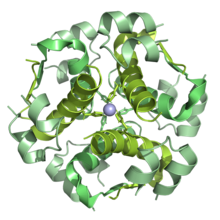
Insulin lispro
Insulin lispro dodecamer 6NWV.png
PDB6NWV
Clinical data
Trade namesHumalog, Liprolog, Admelog, others
Other namesURLi, LY900014, LY-275585, insulin lispro-aabc
AHFS/Drugs.comMonograph
MedlinePlusa697021
License data
  • EU EMAby INN
  • US DailyMedInsulin_lispro
Pregnancy
category
  • AU: A[1]
Routes of
administration
Subcutaneous
ATC code
  • A10AB04 (WHOA10AD04 (WHO)
Legal status
Legal status
  • UK: POM (Prescription only) [2]
  • US: ℞-only
  • EU: Rx-only
  • In general: ℞ (Prescription only)
Identifiers
CAS Number
  • 133107-64-9 check
PubChem CID
  • 16132438
DrugBank
  • DB00046 check
ChemSpider
  • none
UNII
  • GFX7QIS1II
KEGG
  • D04477 check
CompTox Dashboard (EPA)
  • DTXSID90157956 Edit this at Wikidata
Chemical and physical data
FormulaC257H389N65O77S6
Molar mass5813.63 g·mol−1
3D model (JSmol)
  • Interactive image
SMILES
  • CCC(C)C(C(=O)NC(C(C)C)C(=O)NC(CCC(=O)O)C(=O)NC(CCC(=O)N)C(=O)NC(CS)C(=O)NC(CS)C(=O)NC(C(C)O)C(=O)NC(CO)C(=O)NC(C(C)CC)C(=O)NC(CS)C(=O)NC(CO)C(=O)NC(CC(C)C)C(=O)NC(CC1=CC=C(C=C1)O)C(=O)NC(CCC(=O)N)C(=O)NC(CC(C)C)C(=O)NC(CCC(=O)O)C(=O)NC(CC(=O)N)C(=O)NC(CC2=CC=C(C=C2)O)C(=O)NC(CS)C(=O)NC(CC(=O)N)C(=O)O)NC(=O)CN.CC(C)CC(C(=O)NC(CC1=CC=C(C=C1)O)C(=O)NC(CC(C)C)C(=O)NC(C(C)C)C(=O)NC(CS)C(=O)NCC(=O)NC(CCC(=O)O)C(=O)NC(CCCNC(=N)N)C(=O)NCC(=O)NC(CC2=CC=CC=C2)C(=O)NC(CC3=CC=CC=C3)C(=O)NC(CC4=CC=C(C=C4)O)C(=O)NC(C(C)O)C(=O)NC(CCCCN)C(=O)N5CCCC5C(=O)NC(C(C)O)C(=O)O)NC(=O)C(C)NC(=O)C(CCC(=O)O)NC(=O)C(C(C)C)NC(=O)C(CC(C)C)NC(=O)C(CC6=CN=CN6)NC(=O)C(CO)NC(=O)CNC(=O)C(CS)NC(=O)C(CC(C)C)NC(=O)C(CC7=CN=CN7)NC(=O)C(CCC(=O)N)NC(=O)C(CC(=O)N)NC(=O)C(C(C)C)NC(=O)C(CC8=CC=CC=C8)N
InChI
  • InChI=1S/C158H234N40O42S2.C99H155N25O35S4/c1-79(2)57-104(181-131(213)86(15)173-136(218)102(50-53-125(211)212)179-152(234)127(84(11)12)194-148(230)107(60-82(7)8)184-145(227)113(67-95-70-166-78-172-95)189-150(232)115(74-199)176-123(208)73-170-134(216)116(75-241)191-140(222)105(58-80(3)4)182-144(226)112(66-94-69-165-77-171-94)188-138(220)101(48-51-119(161)204)178-146(228)114(68-120(162)205)190-153(235)126(83(9)10)193-132(214)98(160)61-89-31-21-18-22-32-89)139(221)185-110(64-92-40-44-96(202)45-41-92)142(224)183-106(59-81(5)6)147(229)195-128(85(13)14)154(236)192-117(76-242)135(217)169-71-121(206)174-100(49-52-124(209)210)137(219)177-99(38-29-55-167-158(163)164)133(215)168-72-122(207)175-108(62-90-33-23-19-24-34-90)141(223)186-109(63-91-35-25-20-26-36-91)143(225)187-111(65-93-42-46-97(203)47-43-93)149(231)196-129(87(16)200)155(237)180-103(37-27-28-54-159)156(238)198-56-30-39-118(198)151(233)197-130(88(17)201)157(239)240;1-12-46(9)77(121-73(134)36-100)97(156)122-76(45(7)8)95(154)108-56(25-29-75(137)138)80(139)105-54(23-27-70(102)131)83(142)117-66(40-161)93(152)119-68(42-163)94(153)124-79(48(11)127)98(157)116-64(38-126)90(149)123-78(47(10)13-2)96(155)120-67(41-162)92(151)115-63(37-125)89(148)110-58(31-44(5)6)85(144)111-59(32-49-14-18-51(128)19-15-49)86(145)106-53(22-26-69(101)130)81(140)109-57(30-43(3)4)84(143)107-55(24-28-74(135)136)82(141)113-61(34-71(103)132)88(147)112-60(33-50-16-20-52(129)21-17-50)87(146)118-65(39-160)91(150)114-62(99(158)159)35-72(104)133/h18-26,31-36,40-47,69-70,77-88,98-118,126-130,199-203,241-242H,27-30,37-39,48-68,71-76,159-160H2,1-17H3,(H2,161,204)(H2,162,205)(H,165,171)(H,166,172)(H,168,215)(H,169,217)(H,170,216)(H,173,218)(H,174,206)(H,175,207)(H,176,208)(H,177,219)(H,178,228)(H,179,234)(H,180,237)(H,181,213)(H,182,226)(H,183,224)(H,184,227)(H,185,221)(H,186,223)(H,187,225)(H,188,220)(H,189,232)(H,190,235)(H,191,222)(H,192,236)(H,193,214)(H,194,230)(H,195,229)(H,196,231)(H,197,233)(H,209,210)(H,211,212)(H,239,240)(H4,163,164,167);14-21,43-48,53-68,76-79,125-129,160-163H,12-13,22-42,100H2,1-11H3,(H2,101,130)(H2,102,131)(H2,103,132)(H2,104,133)(H,105,139)(H,106,145)(H,107,143)(H,108,154)(H,109,140)(H,110,148)(H,111,144)(H,112,147)(H,113,141)(H,114,150)(H,115,151)(H,116,157)(H,117,142)(H,118,146)(H,119,152)(H,120,155)(H,121,134)(H,122,156)(H,123,149)(H,124,153)(H,135,136)(H,137,138)(H,158,159)/t86-,87+,88+,98-,99-,100-,101-,102-,103-,104-,105-,106-,107-,108-,109-,110-,111-,112-,113-,114-,115-,116-,117-,118-,126-,127-,128-,129-,130-;46-,47-,48+,53-,54-,55-,56-,57-,58-,59-,60-,61-,62-,63-,64-,65-,66-,67-,68-,76-,77-,78-,79-/m00/s1
  • Key:WNRQPCUGRUFHED-DETKDSODSA-N
 ☒check (what is this?)  (verify)

Common side effects include low blood sugar.[3] Other serious side effects may include low blood potassium.[3] Use in pregnancy and breastfeeding is generally safe.[5] It works the same as human insulin by increasing the amount of glucose that tissues take in and decreasing the amount of glucose made by the liver.[3]

Insulin lispro was first approved for use in the United States in 1996.[3][6][7] It is a manufactured form of human insulin where an amino acid has been switched.[8] In 2018, it was the 90th most commonly prescribed medication in the United States, with more than 8 million prescriptions.[9][10]

Medical usesEdit

Insulin lispro is used to treat people with type 1 diabetes or type 2 diabetes.[3] People doing well on regular insulin should not generally be changed to insulin lispro.[3]

Side effectsEdit

Common side effects include skin irritation at the site of injectionhypoglycemiahypokalemia, and lipodystrophy.[6] Other serious side effects include anaphylaxis, and hypersensitivity reactions.[6]

ContraindicationsEdit

Do not administer insulin lispro during episodes of hypoglycemia, or if a person has a hypersensitivity to insulin lispro or any of its excipients.[6]

Mechanism of actionEdit

Through recombinant DNA technology, the final lysine and proline residues on the C-terminal end of the B-chain are reversed. This modification does not alter receptor binding, but blocks the formation of insulin dimers and hexamers. This allows larger amounts of active monomeric insulin to be immediately available for postprandial injections.[11]

ChemistryEdit

It is a manufactured form of human insulin where the amino acids lysine and proline have been switched at the end of the B chain of the insulin molecule.[8]

CostEdit

In the United States, in 2015, the cost was between US$10.06 and US$29.36 per 100 units.[12] In April 2019, Eli Lilly and Company announced they would produce a version selling for US$137.35 per vial, about half the then current cost. The chief executive said that this was a contribution "to fix the problem of high out-of-pocket costs for Americans living with chronic conditions", but Patients for Affordable Drugs Now said this was just a public relations move, as "other countries pay US$20 for a vial of insulin."[13]

The cost in the United Kingdom was between GB£1.66 and GB£1.96 per 100 units, in 2017.[14]

HistoryEdit

Insulin lispro (brand name Humalog) was granted marketing authorization in the European Union in April 1996,[15] and it was approved for use in the United States in June 1996.[7][16]

Insulin lispro (brand name Liprolog) was granted marketing authorization in the European Union in May 1997,[17] and again in August 2001.[18]

Combination drugs combining insulin lispro and other forms of insulin were approved for use in the United States in December 1999.[19][20][21]

Insulin lispro Sanofi was granted marketing authorization as a biosimilar in the European Union in July 2017.[22]

Insulin lispro injection (brand name Admelog) was approved for use in the United States in December 2017.[23][24][25]

In January 2020, the Committee for Medicinal Products for Human Use (CHMP) in the European Union recommended granting of a marketing authorization for insulin lispro acid (brand name Liumjev) for the treatment of diabetes mellitus in adults.[26][27] Insulin lispro (Liumjev) was approved for use in the European Union in March 2020, and in the United States on June 18, 2020 as reported by Medscape.[28]

This article uses material from the Wikipedia article
 Metasyntactic variable, which is released under the 
Creative Commons
Attribution-ShareAlike 3.0 Unported License
.