Pramlintide

 Pramlintide (trade name Symlin) is an injectable amylin analogue drug for diabetes (both type 1 and 2), developed by Amylin Pharmaceuticals (now a wholly owned subsidiary of AstraZeneca).[1] Pramlintide is sold as an acetate salt.
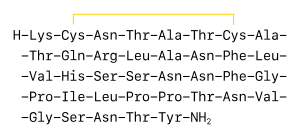
Pramlintide
Pramlintide sequence.svg
Golden line indicates disulfide bond
Clinical data
Trade namesSymlin
AHFS/Drugs.comMonograph
MedlinePlusa605031
Routes of
administration
Subcutaneous
ATC code
  • A10BX05 (WHO)
Legal status
Legal status
  • US: ℞-only
Pharmacokinetic data
Bioavailability30 to 40%
Protein binding~60%
MetabolismRenal
Elimination half-life~48 minutes
Identifiers
CAS Number
  • 151126-32-8 check
PubChem CID
  • 16132446
IUPHAR/BPS
  • 7482
DrugBank
  • DB01278 ☒
ChemSpider
  • 44241191 ☒
UNII
  • D3FM8FA78T
KEGG
  • D05595 ☒
ChEMBL
  • ChEMBL1201669 ☒
Chemical and physical data
FormulaC171H267N51O53S2
Molar mass3949.44 g·mol−1
3D model (JSmol)
  • Interactive image
SMILES
  • CC[C@H](C)[C@@H](C(=O)N[C@@H](CC(C)C)C(=O)N1CCC[C@H]1C(=O)N2CCC[C@H]2C(=O)N[C@@H]([C@@H](C)O)C(=O)N[C@@H](CC(=O)N)C(=O)N[C@@H](C(C)C)C(=O)NCC(=O)N[C@@H](CO)C(=O)N[C@@H](CC(=O)N)C(=O)N[C@@H]([C@@H](C)O)C(=O)N[C@@H](Cc3ccc(cc3)O)C(=O)N)NC(=O)[C@@H]4CCCN4C(=O)CNC(=O)[C@H](Cc5ccccc5)NC(=O)[C@H](CC(=O)N)NC(=O)[C@H](CC(=O)N)NC(=O)[C@H](CO)NC(=O)[C@H](CO)NC(=O)[C@H](Cc6cnc[nH]6)NC(=O)[C@H](C(C)C)NC(=O)[C@H](CC(C)C)NC(=O)[C@H](Cc7ccccc7)NC(=O)[C@H](CC(=O)N)NC(=O)[C@H](C)NC(=O)[C@H](CC(C)C)NC(=O)[C@H](CCCNC(=N)N)NC(=O)[C@H](CCC(=O)N)NC(=O)[C@H]([C@@H](C)O)NC(=O)[C@H](C)NC(=O)[C@@H]8CSSC[C@@H](C(=O)N[C@H](C(=O)N[C@H](C(=O)N[C@H](C(=O)N[C@H](C(=O)N8)[C@@H](C)O)C)[C@@H](C)O)CC(=O)N)NC(=O)[C@H](CCCCN)N
InChI
  • InChI=1S/C171H267N51O53S2/c1-21-81(12)130(163(268)207-110(56-78(6)7)169(274)222-53-33-42-118(222)170(275)221-52-32-41-117(221)160(265)219-135(89(20)230)167(272)206-109(66-125(180)238)151(256)212-128(79(8)9)161(266)186-68-126(239)192-111(70-223)154(259)203-107(64-123(178)236)152(257)218-134(88(19)229)166(271)195-98(136(181)241)57-92-43-45-94(231)46-44-92)214-159(264)116-40-31-51-220(116)127(240)69-187-141(246)101(58-90-34-24-22-25-35-90)199-148(253)105(62-121(176)234)201-149(254)106(63-122(177)235)202-155(260)112(71-224)209-156(261)113(72-225)208-146(251)103(60-93-67-184-75-188-93)205-162(267)129(80(10)11)213-150(255)100(55-77(4)5)198-145(250)102(59-91-36-26-23-27-37-91)200-147(252)104(61-120(175)233)196-137(242)82(13)189-144(249)99(54-76(2)3)197-142(247)96(39-30-50-185-171(182)183)193-143(248)97(47-48-119(174)232)194-165(270)132(86(17)227)215-138(243)83(14)190-157(262)114-73-276-277-74-115(210-140(245)95(173)38-28-29-49-172)158(263)204-108(65-124(179)237)153(258)217-131(85(16)226)164(269)191-84(15)139(244)216-133(87(18)228)168(273)211-114/h22-27,34-37,43-46,67,75-89,95-118,128-135,223-231H,21,28-33,38-42,47-66,68-74,172-173H2,1-20H3,(H2,174,232)(H2,175,233)(H2,176,234)(H2,177,235)(H2,178,236)(H2,179,237)(H2,180,238)(H2,181,241)(H,184,188)(H,186,266)(H,187,246)(H,189,249)(H,190,262)(H,191,269)(H,192,239)(H,193,248)(H,194,270)(H,195,271)(H,196,242)(H,197,247)(H,198,250)(H,199,253)(H,200,252)(H,201,254)(H,202,260)(H,203,259)(H,204,263)(H,205,267)(H,206,272)(H,207,268)(H,208,251)(H,209,261)(H,210,245)(H,211,273)(H,212,256)(H,213,255)(H,214,264)(H,215,243)(H,216,244)(H,217,258)(H,218,257)(H,219,265)(H4,182,183,185)/t81-,82-,83-,84-,85+,86+,87+,88+,89+,95-,96-,97-,98-,99-,100-,101-,102-,103-,104-,105-,106-,107-,108-,109-,110-,111-,112-,113-,114-,115-,116-,117-,118-,128-,129-,130-,131-,132-,133-,134-,135-/m0/s1 ☒
  • Key:TZIRZGBAFTZREM-MKAGXXMWSA-N ☒
 ☒check (what is this?)  (verify)

PharmacologyEdit

Pramlintide is an analogue of amylin, a small peptide hormone that is released into the bloodstream by the β cells of the pancreas along with insulin after a meal.[2] Like insulin, amylin is completely absent in individuals with Type I diabetes.[3]

In synergy with endogenous amylin, pramlintide aids in the regulation of blood glucose by slowing gastric emptying, promoting satiety via hypothalamic receptors (different receptors than for GLP-1), and inhibiting inappropriate secretion of glucagon, a catabolic hormone that opposes the effects of insulin and amylin. Pramlintide also has effects in raising the acute first-phase insulin response threshold following a meal.

Both a reduction in glycated hemoglobin and weight loss have been shown in insulin-treated patients with type 2 diabetes taking pramlintide as an adjunctive therapy.[4]

ApprovalEdit

Pramlintide has been approved by the FDA, for use by type 1 and type 2 diabetic patients who use insulin.[5] Pramlintide allows patients to use less insulin, lowers average blood sugar levels, and substantially reduces what otherwise would be a large unhealthy rise in blood sugar that occurs in diabetics right after eating.

Apart from insulin analogs, pramlintide is the only drug approved by the FDA to lower blood sugar in type 1 diabetics since insulin in the early 1920s.[citation needed][6]

Design and structureEdit

Since native human amylin is highly amyloidogenic and potentially toxic, the strategy for designing pramlintide was to substitute residues from rat amylin, which is less amyloidogenic although not completely [7][8] (but would presumably retain clinical activity). Proline residues are known to be structure-breaking residues, so these were directly grafted into the human sequence. Despite its enhanced stability compared to human amylin, pramlintide is still able to organize into amyloid material.[9]

Amino acid sequences:

PramlintideKCNTATCATQRLANFLVHSSNNFGPILPPTNVGSNTY-(NH2)
AmylinKCNTATCATQRLANFLVHSSNNFGAILSSTNVGSNTY-(NH2)
Rat amylinKCNTATCATQRLANFLVRSSNNLGPVLPPTNVGSNTY-(NH2)

Pramlintide as protein is (positively charged).

This article uses material from the Wikipedia article
 Metasyntactic variable, which is released under the 
Creative Commons
Attribution-ShareAlike 3.0 Unported License
.